
Jefferson County’s Multi-Day Arrest Record
JCSO posts no page titled weekly blotter. The closest official equivalent pairs two sources: the date-sorted Jefferson County roster and the sheriff's press-release archive. The roster is the booking side. Press releases are selected agency narratives. They answer different questions, so keep them separate.
Deeper pages reach back weeks. Each roster page holds 40 entries, and page 2 has carried arrests into early August while page 4 reached late July. That depth shifts constantly. New bookings push older entries back, releases remove names, and JCSO adjusts its system, so treat pagination as a live list rather than a fixed archive.
Read the Jefferson County Blotter
The smart way to read the blotter is backward by date. Start with the newest arrests. Keep the booking roster apart from press coverage. That discipline catches entries beyond a same-day screen while preserving what each source actually means.
- Open the official roster and choose newest-to-oldest order. Note the date and time of the search.
- Review the first results page, then open deeper pagination such as the 40-record and 80-record states.
- Match the person's name, booking number, and booking date. Do not rely on a photo as the sole identifier.
- Check Current and Released when available. A release control error should be resolved with JCSO or VINE.
- Search the sheriff press archive for a related official announcement, operation, or data correction.
- For a fresh entry within one day, switch to Arrests Last 24 Hours.
A city police report is not a booking card. Pine Bluff, White Hall, and Redfield publish no photo-bearing city arrest feeds to match the JCSO roster. When those agencies deliver a person to DBDC, the county record is the central booking source. Need the separate incident report? Ask the arresting department.
Jefferson County Arrest Pagination
The deeper official roster view shows the next page of Jefferson County arrests. The list keeps going. Newer bookings appear first. Older arrest records sit on pages like this one.
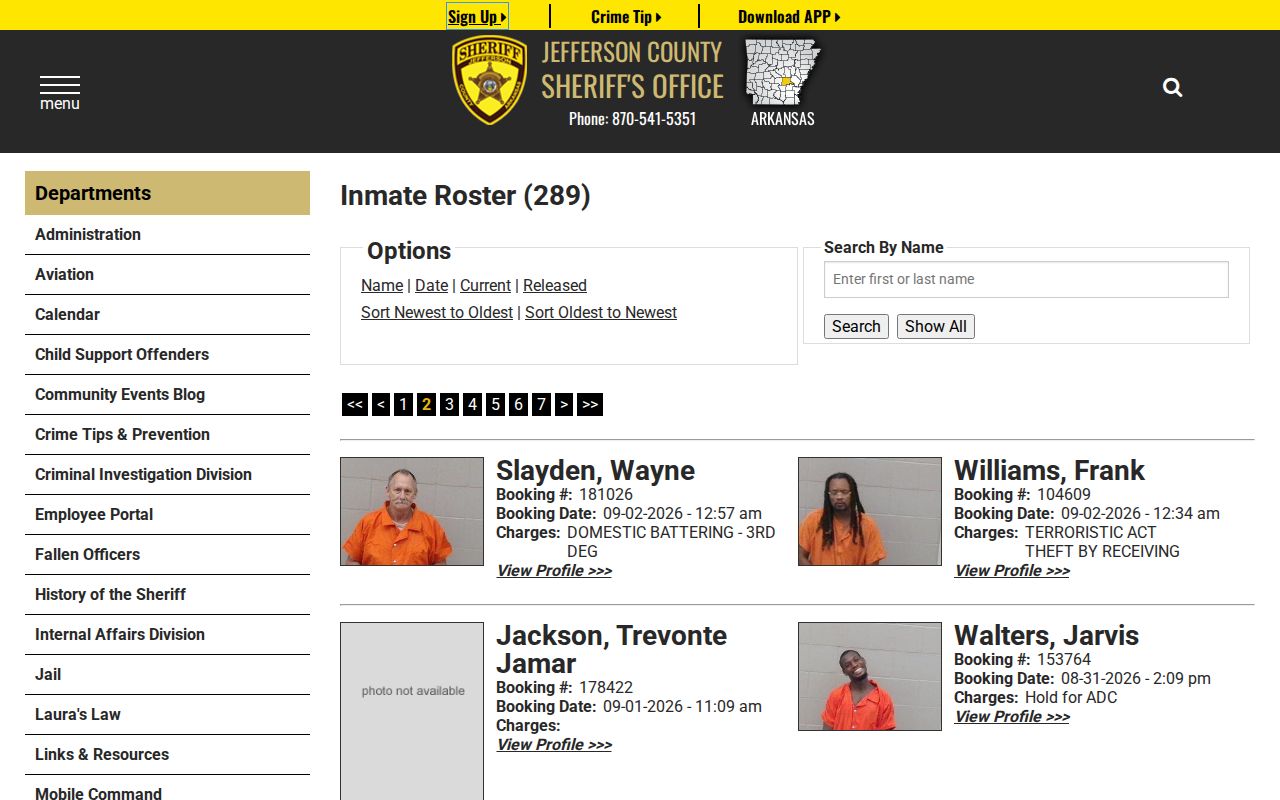
Pagination helps with date research. It is still just a changing website state, not the county's permanent jail-log archive. Four custody stages complicate the picture. A just-arrested person may sit in intake. A current inmate appears on the active roster. A released person moves to the Released view or drops off entirely. Someone transferred to state custody belongs in the Arkansas Department of Corrections offender search, and no single multi-day screen covers all four states.
Fields in a Jefferson Arrest Entry
The web card shows a subset of the jail's full record. Internal intake files hold fingerprints, search and housing data, and warrant checks the public never sees. Those operational details stay off the site. Only the published fields belong in a blotter reading.
| Roster field | Meaning and limit |
|---|---|
| Full name | The identity label used on the booking entry; verify spelling and aliases. |
| Booking number | The intake reference useful for a follow-up call or records request. |
| Booking date and time | The jail's displayed intake time, not necessarily arrest time or web upload time. |
| Charge text | The charge recorded when booked; it may change in court. |
| Booking photograph | An intake identification image where JCSO publishes one. |
| Profile link | A route to additional available details; historic fields are not guaranteed. |
Every card skips something. Bond, court date, agency, or disposition may be absent. Disposition means the court's eventual result, whether dismissal, acquittal, or conviction. For those gaps, the Jefferson County arrest-record hub connects the jail entry to court and record-request sources.
Weekend Jefferson Arrest Patterns
JCSO publishes no weekend batch time or holiday posting schedule. A Monday cluster can mean several things. Arrests may have stacked up over Saturday and Sunday. Intake may have finished late, the public site may have synced slowly, or plain sorting may be at work. Never call it a crime surge.
Every entry shows a booking time. Use it to place arrests within your date range. Then check Released for people who left custody before the search. A conflicting status deserves a call to DBDC booking at 870-541-1921. VINE can supplement the roster for lawful custody tracking, but it never replaces the county booking record.
Does a Monday list show all weekend arrests? Not necessarily. The web cadence is unpublished. Someone may have been released, booked elsewhere, legally withheld, or simply not synced yet.
Verify Jefferson County Release Status
A sheriff notice from December 2025 described a Tiger system synchronization error. Incorrect release information hit the public site. Internal data stayed accurate. The fault matters for multi-day work. A record viewed one day may show a corrected state later, so the official JCSO press archive, which posts system notices and enforcement announcements, is a companion worth keeping open.
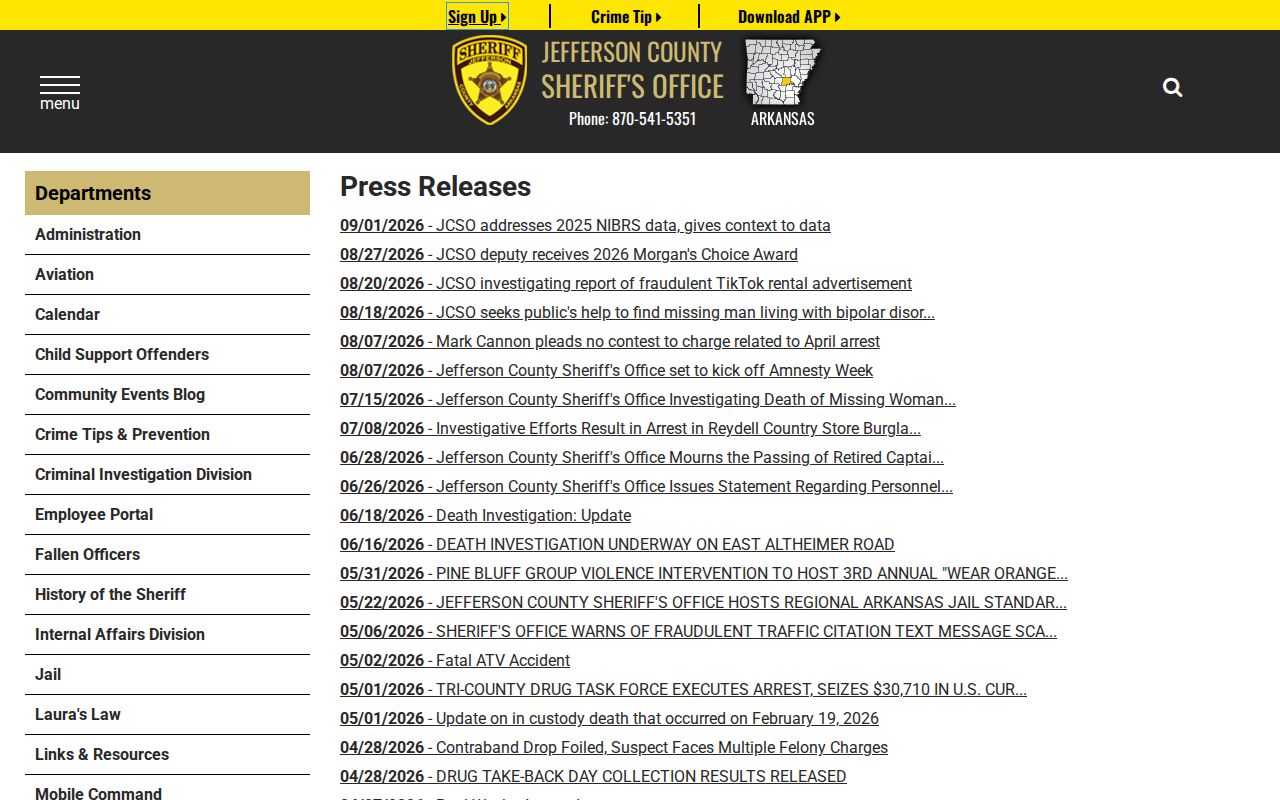
The archive explains why data changed. It cannot confirm present status. Only JCSO or a participating custody service can do that. Preserve the "last checked" context whenever you cite a record. Compare the roster with VINE. A murky status may need a direct call to the jail. Never infer an exact release date from unofficial sites. One official correction outweighs a dozen stale copies of the same error.
Local News Is Not the Blotter
Start with official records, always. News outlets choose what to cover, and that choice skews the picture. Deltaplex Mugshots runs booking-style posts with booking IDs, dates, demographic details, and charges. The same site's Crime Beat section gathers selected public-safety stories instead. Neither one shows who is actually in custody right now. The Crime Beat page reads like narrative local reporting. It is not a complete Jefferson County arrest list. That gap matters when you need current booking data.

A news story can point you toward an agency release. Still, check its custody claims against JCSO and court records yourself. The Pine Bluff Commercial covers selected crime and sheriff's-office reporting rather than a routine booking docket. Over at South Ark Daily, county and police-style tags group arrest and public-safety items the site chooses to carry. Aggregators like RecentlyBooked, Arrests.org, Busted Newspaper, and Mugshots.zone keep rolling copies too. None of them are official, entries go stale fast, and nothing there settles whether someone is in custody now. Their images should never be republished as a gallery.
Older Jefferson County Arrest Archives
Roster depth online and legal retention are two different things. Arkansas Code § 13-4-404 sets a floor of five years for county jail booking records. It covers booking photos, fingerprint cards, and jail detention logs. Past that point, disposal can happen by county judge order on the sheriff's recommendation. Even within five years, the public website may not keep every card posted.
The state's jail-log rule, 12 CAR § 50-503, spells out what a log holds. It lists arrest, confinement, and release times. It also names the reason for confinement, the officers involved, and warrant or commitment data. Don't assume the website is the archive. Request a specific historical jail log instead. Give JCSO the full name, any aliases, a date range, and the item you want. If the search comes up empty, ask for the non-exempt booking card, photo, release entry, or jail log. Ask also for a retention or disposition statement.
For deep historical work, the Arkansas State Archives runs research services. Staff there ask for names, dates, county, and a description of the record. Modern DBDC booking photos do not move there automatically. Sealed records, juvenile confidentiality, and victim privacy all apply. So do other exemptions, no matter which route you take.
Jefferson Arrest Logs Require Context
Context makes a Jefferson County arrest log useful. A booking entry marks a moment, not an outcome. Charges can change after arrest. Prosecutors may reduce them or drop them entirely. Court records tell the rest of the story.
Put these sources to practical use. Status checks, journalism, historical research, lawful notice, and court navigation all fit. Verify identity and final outcome with the agency that made the arrest and the court handling the case. Handle every booking photograph with respect, and never rank, sensationalize, or republish people from the list.